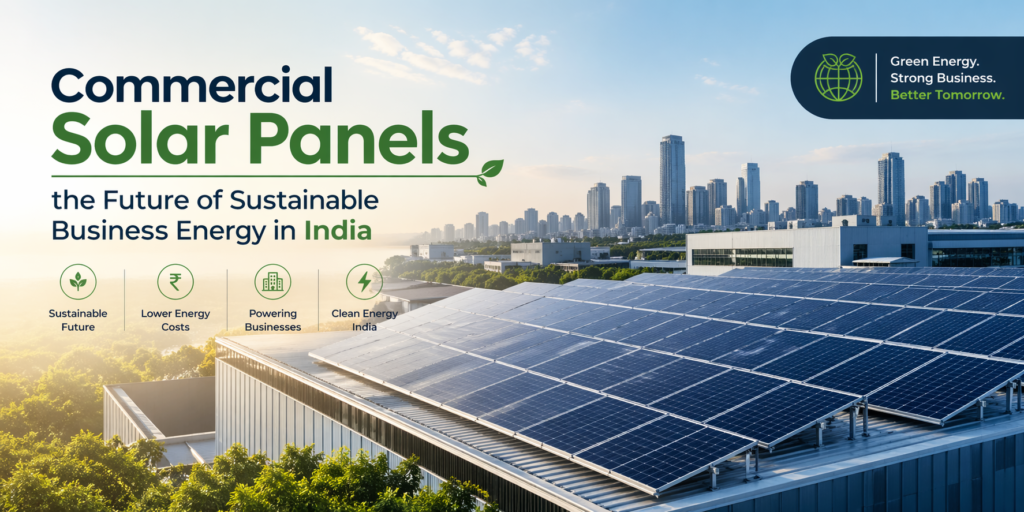
businesses across India are increasingly adopting commercial solar panels to reduce operating costs and fulfill sustainability dreams. Rising power costs, ancillary government jobs and investing in solar power system for business has become a practical and forward-thinking option for companies searching for answers through systems Ask Zero Carbon Discovers that solar isn’t just an environmentally friendly option—it’s a strategic business move.
Why Businesses are Turning to Solar Energy
Industrial and commercial sectors in India consume a huge chunk of the power sector, making them tremendously vulnerable to fluctuating tariffs. By adopting industrial & commercial solar solutions, groups can reduce their reliance on traditional electricity sources to generate their own clean power. Solar power provides long-term monetary balance, allowing businesses to control their electricity prices and strengthen their environmental responsibilities.
Beyond the fee financial savings, Sun Adoption makes up for the logo fee. Businesses that spend money on renewable energy often gain competitive advantage by aligning with sustainability-driven customers and stakeholders. This transition also helps with India’s broader accessible energy goals, contributing to a greener economy.
Understanding Commercial Solar Installation Costs
An important consideration for any business is commercial solar installation cost. In India, depending on system length, equipment rod and setup complexity Larger structures tend to cost less per kilowatt due to economies of scale, making them particularly attractive to medium-sized enterprises.
While even the initial investment may seem expensive, the long-term returns are compelling. Most companies make good on their investment in some years through savings on electricity bills. After the payback length, solar equipment will continue to generate free power for decades, making it a fantastically profitable investment over time.
Rooftop Solar For Office Building
One of the most practical packages of sun generation is Rooftop Solar For Office Building setups. Office buildings often have underused roof area that can be converted into an efficient power supply. Installing rooftop solar panels can set up clusters to generate electricity on the grid without the need for additional land.
This approach is now not the simplest reducing power bills yet also being disruptive and seamlessly integrated into outdoor every day operations. Over time, roof structures contribute, particularly in reducing operating charges and enhancing power performance. For many groups, this solution is the first step closer to full energy independence.
Commercial Solar Panel Price in India
Commercial solar panel price depends on several elements, including panel performance, logo popularity, and technological improvements. On an average, solar panels in India cost depending on the wattage, while the cost of normal gadgets can additionally depend entirely on additional connectors such as inverter mounting systems.
It is important to choose hefty panels for long-term performance. While lower tariff options can additionally reduce upfront charges, premium panels offer higher efficiency, durability and reliability. Businesses should focus solely on the total lifecycle value as opposed to the initial charge, ensuring a stable energy epoch over the life of the device.
Open Access Solar Power in India
For those groups that lack sufficient roof space, Open Access Solar Power In India offers a powerful opportunity. This model allows agencies to buy solar electricity from online solar plant life off the website instead of you installing panels in your neighborhood. It is especially useful for large industries with high power requirements.
Open get right of entry to enables groups to access renewable energy without heavy capital funding. By entering into agreements with solar power producers, businesses can enjoy lower energy costs while preserving flexibility in purchasing power.
Open Access Solar Policy and Tariff
Growth in open access to solar is supported through the Open Access Solar Policy, which allows businesses to buy electricity directly from renewable electricity vendors These rules vary by state but generally encourage the adoption of affordable power through simplification of regulatory techniques.
Open access solar tariff are generally lower than traditional grid price lists, making them an attractive option for cost-conscious corporations. In addition, long-term agreements make certain rate stability, protecting agencies from the fate that electricity prices will rise. This predictability is especially valuable for industries that rely heavily on static force distribution.
Industrial and Commercial Solar Solutions for Every Business
Modern industrial and commercial solar solutions are designed to meet the needs of various enterprises. Whether it’s a small workstation for miles or a large production unit, solar structures can be customized based on power consumption styles. Businesses can choose from on-grid, hybrid, or off-grid systems based on their operational needs.
This flexibility allows organizations to optimize their electricity usage and maximize savings. As the generation adapts, solar solutions have become more efficient, reliable and on hand, making them suitable for a large range of packages.
Conclusion
The adoption of commercial solar panels is reshaping the way companies in India approach electricity consumption. With lower commercial solar panel prices, viable commercial solar installation costs, and supportive frameworks like open access solar policies, solar power has grown to be a viable and attractive option for businesses of all sizes.
Whether through Rooftop Solar For Office Building installations or Open Access Solar Power In India, agencies can achieve significant cost and financial savings while reducing their environmental impact. Investing in a solar power system for a business doesn’t always mean drastically reducing prices—it’s about miles away from creating a sustainable and future-ready business enterprise.