Madhya Pradesh Clarifies Open Access Billing Rules to Strengthen Renewable Power Adoption

Madhya Pradesh has taken a significant step toward improving regulatory clarity for renewable energy consumers by amending its open access regulations. The latest changes, introduced under Regulation 13.2, define key aspects of billing, metering, and surcharge mechanisms—bringing greater transparency and predictability for commercial and industrial electricity users.

What Has Changed?

Under the revised framework, eligible consumers must now clearly specify their open access requirement at the application stage. They need to indicate whether open access power will be used:

– Up to their existing contract demand
– Beyond their contract demand
– Or for both scenarios

This early declaration helps utilities plan load management better and reduces ambiguity during billing and settlement.

Billing Clarity for Consumers

One of the most important clarifications relates to billing treatment. For consumers opting for open access within their approved contract demand, the Commission has specified that:

– Only energy adjustment will be permitted
– Demand adjustment will not be included in billing demand calculations

This distinction is crucial because demand charges often form a significant portion of electricity bills. By separating energy and demand treatment, the regulation provides clearer financial visibility for businesses planning renewable procurement.

Why This Matters for Businesses

For industries and large commercial establishments, regulatory uncertainty has often been a barrier to adopting open access solar or wind power. The updated rules reduce this risk by clearly defining how consumption, demand, and surcharges will be handled.

States like Gujarat, Rajasthan, and Karnataka have already seen strong open access growth due to policy clarity. Madhya Pradesh’s move is expected to encourage similar momentum, particularly among manufacturing units, data centers, and large commercial campuses seeking long-term energy cost optimization.

Supporting India’s Clean Energy Transition

Open access plays a critical role in helping India achieve its renewable energy targets. By enabling large consumers to procure green power directly, it reduces grid pressure, supports private renewable investment, and accelerates corporate sustainability commitments.

With clearer regulations now in place, businesses in Madhya Pradesh can plan renewable procurement strategies with greater confidence—moving toward lower costs, energy security, and reduced carbon footprints.

Policy Impact
Regulatory clarity reduces financial uncertainty for open access renewable procurement decisions
Energy-only adjustment improves cost predictability for contract demand consumers significantly
Early declaration requirement enhances grid planning and operational transparency statewide
Amendments expected to accelerate industrial renewable adoption across Madhya Pradesh
Clear billing framework strengthens investor confidence in long-term open access projects

NHPC’s 16.64 MW Rooftop Solar Tender Signals Strong Growth in Government Solar Adoption

India’s rooftop solar momentum continues to accelerate as NHPC has floated a tender for 16.64 MW rooftop solar installations across government buildings under the Renewable Energy Service Company (RESCO) model. The bid submission deadline is March 18, 2026, and the initiative is aligned with the government’s flagship PM Surya Ghar: Muft Bijli Yojana, aimed at scaling distributed solar adoption across the country.

Driving Government-Led Solar Expansion

Government buildings represent a massive untapped opportunity for rooftop solar deployment. By adopting the RESCO model, NHPC is enabling implementation without upfront capital investment from building owners. Instead, developers invest, install, operate, and recover costs through long-term power purchase agreements.

This model reduces financial risk while ensuring reliable clean power at lower tariffs. Similar frameworks have already seen success in states like Gujarat, Rajasthan, and Karnataka, where public infrastructure is increasingly transitioning to renewable energy.

Why the RESCO Model Matters

The RESCO approach is emerging as a key driver for India’s distributed solar growth. It allows organizations to:

– Reduce electricity costs immediately
– Avoid capital expenditure
– Transfer performance and maintenance risk to developers
– Ensure long-term operational efficiency

For government institutions managing budget constraints, this structure provides both financial flexibility and sustainability benefits.

Alignment with India’s Clean Energy Goals

The tender supports India’s broader renewable targets and contributes to reducing carbon emissions from public infrastructure. With rooftop solar playing a crucial role in meeting the country’s 500 GW renewable capacity target by 2030, such initiatives demonstrate how policy, public sector demand, and private execution are coming together.

The integration of distributed solar also reduces grid dependency, lowers transmission losses, and improves energy resilience—critical factors for urban infrastructure.

Opportunities for the Solar Ecosystem

This NHPC tender signals strong demand for experienced EPC and RESCO developers capable of executing multi-location projects efficiently. As PM Surya Ghar and other central schemes expand, similar opportunities are expected across ministries, public sector undertakings, and state agencies.

For the industry, the message is clear: distributed solar is moving from pilot scale to mainstream deployment, with government demand acting as a major growth catalyst.

Key Insights

Government rooftops emerging as large-scale distributed solar opportunity across India
RESCO model reduces capital risk and ensures long-term performance accountability
PM Surya Ghar accelerating public sector renewable energy adoption nationwide
Multi-location execution capability becoming critical for large rooftop deployments
Policy-driven demand expected to expand government solar tenders significantly

Union Budget 2026 Reduces Solar Duties, Strengthening India’s Manufacturing and Adoption Ecosystem

India’s renewable energy sector received a major boost in the Union Budget 2026–27, with targeted duty reductions aimed at lowering costs and strengthening domestic manufacturing. The government has reduced effective duties on solar modules to 20% and rebalanced Basic Customs Duty (BCD) and cess on solar cells to improve overall project viability.

These changes come at a critical time as India accelerates toward its ambitious clean energy targets and the Net Zero 2070 vision.

Lower Costs, Better Project Economics

One of the biggest impacts of the budget will be improved financial viability for solar projects. Lower duties on modules and cells directly reduce capital costs for utility-scale plants, commercial rooftop systems, and industrial installations. For businesses evaluating solar, even a small percentage reduction can significantly shorten payback periods and improve long-term returns.

Additionally, the removal of the 7.5% BCD on sodium antimonate—a key raw material used in solar glass—will help domestic manufacturers lower production costs. This move strengthens India’s solar supply chain and supports the growth of local players competing with global manufacturers.

Strengthening Domestic Manufacturing and Storage

The budget also extends duty exemptions on capital goods used in lithium-ion battery cell manufacturing. This is a strategic step toward integrating energy storage with solar projects, especially for industries, data centres, and large commercial consumers that require reliable round-the-clock power.

With states like Gujarat, Rajasthan, and Tamil Nadu expanding solar capacity and companies such as Tata Power and Adani Green investing heavily, policy support for manufacturing and storage will help India build a more resilient renewable ecosystem.

What This Means for Businesses

For commercial and industrial consumers, the timing is significant. Lower equipment costs, improving storage economics, and supportive policies mean rooftop solar and hybrid solutions are becoming more attractive than ever. Combined with net metering benefits and accelerated depreciation, businesses can now achieve faster ROI while reducing energy risks and carbon footprint.

As policy momentum continues, early adopters will benefit the most from falling costs and improving technology.

Key Takeaways:

Budget Gains
– Reduced duties lower solar project costs and improve investment returns
– Domestic manufacturing support strengthens India’s solar supply chain ecosystem
– Battery incentives accelerate solar-plus-storage adoption for reliable power solutions
– Policy stability encourages faster commercial and industrial solar decision-making
– Early adopters benefit from falling costs and stronger long-term energy economics

Robotic Cleaning Emerges as Game-Changer for Solar Efficiency in Dusty Indian Regions

India’s solar journey is entering a more operationally mature phase. While capacity additions continue at scale, attention is shifting to something equally critical—maintaining generation efficiency on the ground. In dust-heavy regions like Rajasthan and Maharashtra, this focus is driving rapid adoption of robotic solar panel cleaning, especially among farmers and feeder-level project owners.

Dust: The Silent Generation Killer
Dust accumulation has long been a challenge for Indian solar assets. In arid belts of Rajasthan and semi-arid regions of Maharashtra, studies and on-ground data show that uncleaned panels can lose 15–25% of their generation capacity within weeks. For small and medium solar projects connected to agricultural feeders, this loss directly impacts revenue and grid stability.

Why Manual Cleaning Is No Longer Viable
Traditional manual cleaning methods are proving increasingly unsustainable. They require large volumes of water—an acute concern in water-scarce regions—and depend on regular labor availability, which is both costly and inconsistent. Safety risks, uneven cleaning quality, and downtime further reduce their effectiveness, particularly for distributed or remote solar installations.

Rajasthan’s Numbers Tell the Story
Data emerging from Rajasthan-based solar projects clearly demonstrates the impact of automation. Projects that shifted to robotic cleaning reported generation gains of 8–15% annually, with consistent performance even during peak dust seasons. Importantly, these systems operate without water, aligning well with India’s broader sustainability goals and water conservation priorities.

Small Projects, Big Operational Constraints
Feeder-level and smaller solar projects face unique challenges. Margins are tight, O&M teams are lean, and any generation loss hurts faster. Robotic cleaning offers a scalable solution, lightweight, programmable systems that can be deployed across smaller arrays without heavy infrastructure changes. As costs of robotic systems decline, adoption is accelerating.

A Shift in Solar O&M Thinking
The rise of robotic cleaning reflects a broader shift in India’s solar sector—from capacity-first to performance-first thinking. As India pushes toward its 2030 renewable targets and long-term net-zero commitments, technologies that protect generation output will play a decisive role.

For project owners and EPC players, the message is clear: automation in solar O&M is no longer optional in dusty geographies—it’s essential for sustaining returns and reliability.

Key Takeaways:
– Dust significantly reduces solar output in arid Indian regions
– Manual cleaning is water-heavy and operationally inefficient
– Robotic systems deliver consistent, measurable generation gains
– Rajasthan data validates automation’s financial and technical case
– Solar O&M is shifting toward performance-driven automation

Why Execution Capability and EPC Excellence Are Now Defining India’s Solar Leaders

India has moved into a new phase of its solar journey. The early years were defined by capacity addition—how many megawatts were installed and how fast. Today, the focus has decisively shifted. Execution capability is becoming the real currency in solar. The quality of decisions across the project lifecycle now determines whether a solar plant becomes a long-term asset or a short-lived installation.

From land selection and site grading to layout optimisation, equipment integration, and risk management, every stage impacts generation performance. Poorly planned land can lead to shading and drainage issues. Sub-optimal layouts reduce energy yield. Weak integration between modules, inverters, and BOS components increases downtime. These are not minor errors—they directly affect plant profitability for 25 years.

EPC Excellence as the Core Differentiator

In this environment, EPC capability has become the strongest competitive advantage. Companies that bring engineering depth, process discipline, and on-ground execution strength are shaping India’s next solar wave. It is no longer enough to win tenders; projects must be built to perform consistently in Indian conditions—high temperatures, dust, monsoons, and grid variability.

This is especially critical as India scales up ambitious targets under initiatives like PM Surya Ghar, state solar policies in Rajasthan, Gujarat, Maharashtra, and Tamil Nadu, and large renewable investments by players such as Adani Green, Tata Power, and ReNew. As capacities grow, so does complexity—and execution quality becomes the difference between success and underperformance.

The Power of Strong Manufacturing Linkages

Another defining factor is manufacturing linkage. EPCs with direct relationships with Tier-1 module, inverter, and structure manufacturers are better positioned to manage quality, timelines, and warranties. With India pushing domestic manufacturing under Make in India and PLI schemes, tight integration between EPC and manufacturing is reducing supply risk and improving lifecycle performance.

Strong linkages also ensure faster resolution of defects, better technology access, and long-term support—critical for assets expected to operate for decades.

Turning Megawatts into Assets

India’s next phase of solar expansion will be shaped by those who can combine ambition with execution strength. The goal is no longer just to commission projects, but to turn megawatts into productive, resilient assets that deliver predictable returns year after year.

For developers, corporates, and institutions, choosing the right EPC partner is now a strategic decision—not a procurement exercise. Those who prioritise execution capability will lead the market.

As India accelerates its renewable journey, now is the time to partner with execution-focused EPCs who understand engineering, manufacturing, and lifecycle performance. The future of solar belongs to those who build it right.

Key Shifts:
– Execution quality now defines long-term solar asset performance and financial returns
– EPC excellence is replacing capacity as the true competitive advantage
– Manufacturing integration reduces risk and improves project reliability
– Lifecycle thinking is reshaping how solar projects are planned and built
– India’s solar leaders will be those who execute, not just announce

Uttar Pradesh’s AI City in Lucknow Sets New Benchmark for Renewable-Powered Tech Hubs

Uttar Pradesh is making a bold statement in India’s clean energy and digital transformation journey. The state’s upcoming Artificial Intelligence City in Lucknow is being designed to operate entirely on renewable energy, positioning it among the first large technology hubs in the country with a fully green power backbone.

According to state officials, the project will integrate solar power, green hydrogen, and other clean energy sources into every layer of its infrastructure. This includes data centres, research facilities, smart buildings, mobility systems, and urban utilities. The vision is clear: build a next-generation digital ecosystem without increasing carbon emissions.

Why This Is a Game Changer

Data centres and AI infrastructure are known for their heavy energy consumption. Traditionally, such facilities rely on coal-heavy grid power, adding pressure on India’s emissions targets. By committing to 100% renewables, UP is aligning innovation with sustainability, proving that high-performance computing and green energy can coexist.

This move also supports India’s Net Zero 2070 commitment and complements national initiatives like PM Surya Ghar Muft Bijli Yojana and the National Green Hydrogen Mission. States like Gujarat and Rajasthan have already demonstrated leadership in solar adoption, and UP is now emerging as a serious player in the renewable-driven digital economy.

Economic and Environmental Impact

A renewable-powered AI City reduces long-term operational costs, insulates infrastructure from tariff volatility, and enhances investor confidence. For global tech firms, sustainability is no longer optional—it is a boardroom priority. By offering green-powered infrastructure, UP strengthens its position as a destination for high-value investments.

From rooftop solar on commercial buildings to large open access solar plants and hydrogen blending, this project will likely create strong demand for renewable EPCs, technology providers, and energy storage solutions across North India.

What This Means for India’s Solar Ecosystem

This initiative sends a powerful signal to developers, industries, and institutions: the future belongs to clean, decentralised energy. As smart cities, industrial parks, and tech hubs come up across the country, renewable integration will become standard, not optional.

The AI City model can be replicated in other states, accelerating adoption of rooftop solar, open access solar, and hybrid energy systems across India’s commercial landscape.

Call to Action:
If you are planning a data centre, IT park, industrial campus, or smart infrastructure project, now is the time to design it around clean energy. The future of growth in India will be green by default.

Future Signals:
– AI infrastructure can scale sustainably using 100% renewable power models
– Solar and hydrogen integration will redefine large technology campus design
– States investing early will attract premium global technology investments
– Renewable energy will become core to smart city planning
– India’s digital growth will be anchored in clean energy ecosystems

MERC Net Metering Order with Open Access Brings Major Relief to Commercial Solar Users

In a landmark decision that strengthens India’s rooftop solar ecosystem, the Maharashtra Electricity Regulatory Commission (MERC) has directed MSEDCL to allow net metering for rooftop solar systems even when the consumer is availing open access. This ruling came in favour of Hatsun Agro Products, whose rooftop solar system was earlier billed under gross metering despite using open access power.

The Commission has also ordered MSEDCL to **revise and adjust Hatsun Agro’s electricity bills from November 2023**, applying net metering instead of gross metering. This move is being widely welcomed across the industry as it removes a long-standing regulatory ambiguity and encourages wider adoption of rooftop solar by large commercial and industrial consumers.

Why This Decision Matters

Many businesses in Maharashtra and other states use open access to procure cheaper power from the market. However, discoms often denied them net metering benefits for rooftop solar, pushing them into gross metering—resulting in lower financial returns. MERC’s decision clarifies that rooftop solar and open access can coexist, unlocking better economics for businesses.

This is particularly important for sectors like **food processing, manufacturing, data centers, hospitals, and large institutions**, where energy costs form a significant part of operating expenses. With net metering restored, these consumers can now optimally use their rooftop solar generation while continuing open access procurement.

Government Push on Captive Power Rules

Adding to this momentum, the central government has proposed **changes to captive power rules to ease compliance**. This will simplify structures for businesses using captive renewable power, reduce regulatory friction, and make it easier for companies to meet renewable purchase obligations (RPOs) and ESG targets.

### **What This Means for Indian Businesses**

Together, these developments reflect a strong policy intent to:

  • Encourage decentralised renewable energy
  • Reduce dependency on fossil fuel-based grid power
  • Support India’s Net Zero 2070 commitment
  • Improve ease of doing business for renewable adopters

States like Maharashtra, Gujarat, and Rajasthan are emerging as leaders in progressive solar regulation, making rooftop solar, open access, and captive models more viable than ever.

For companies exploring rooftop solar, open access, or hybrid models, this is the right time to act. Policy support, regulatory clarity, and falling solar costs together make the business case extremely compelling.

If your business is evaluating rooftop solar with open access or captive models, now is the time to design the right structure and maximise savings.

Key Takeaways:

MERC allows net metering even with open access usage
Hatsun Agro receives retrospective bill correction from November 2023
Gross metering replaced with favourable net metering methodology
Policy clarity boosts commercial rooftop solar confidence significantly
Easing captive rules will accelerate renewable adoption for industries


750 kW Rooftop Solar Saves ₹8 Million Annually

India’s manufacturing sector is increasingly turning to rooftop solar to control rising electricity costs, improve energy reliability, and meet sustainability goals. A strong example of this transition is the 750 kW rooftop solar installation at Abhirami Pet Industries, located in Tirunelveli, Tamil Nadu. This commercial solar project clearly demonstrates how renewable energy can transform industrial economics while supporting long-term environmental responsibility.

Commercial Solar Project in India: 750 kW Rooftop Case Study

Abhirami Pet Industries in Tamil Nadu installed a 750 kW rooftop solar system at its Tirunelveli facility. The system generates approximately 3,800 units daily and 114,000 units monthly, meeting nearly 75% of the plant’s electricity needs.

This installation delivers annual savings of ₹8 million, demonstrating how rooftop solar transforms manufacturing economics. With consistent generation and reduced grid dependency, the facility has significantly improved cost predictability and sustainability.

Zero Carbon specializes in executing large-scale rooftop solar projects like this across PAN India, delivering measurable savings and long-term performance assurance.

Rooftop Solar Just Got Cheaper—And Payback Got Faster

  • Explain how GST cuts reduce upfront solar costs

  •  Show real payback impact for businesses

  • Highlight why delaying solar now costs more

  • Connect policy change to long-term savings

Rooftop solar has quietly crossed a major affordability milestone in India. With recent GST adjustments, rooftop solar system costs have dropped by 7–10%, making clean energy more accessible for MSMEs, hospitals, schools, banks, and factories. This may sound like a small percentage, but when applied to capital-intensive systems, the impact on payback and lifetime savings is significant.

For a typical commercial rooftop installation, capital cost is the biggest mental barrier. A 100 kW system that earlier required ₹45–50 lakh can now be installed at noticeably lower cost. That reduction directly shortens the payback period by 6–12 months, depending on consumption patterns. For energy-intensive users paying ₹9–₹14 per unit from the grid, this means faster breakeven and higher internal rate of return. In simple terms, businesses start saving sooner.

What makes this moment important is timing. Electricity tariffs continue to rise 5–8% annually, while solar technology costs keep falling. GST rationalisation accelerates this trend. The economics now clearly favour immediate adoption. Waiting no longer means “thinking it through”; it means paying inflated bills while missing cheaper installation windows. Every delayed month is another high-cost electricity bill locked in.

For institutions like hospitals and schools that operate year-round, or BFSI branches with predictable loads, the savings are tangible. A mid-sized hospital can save ₹20–40 lakh per year after installing rooftop solar. With reduced system cost, those savings now compound faster. Over a 25-year system life, the difference created by a 7–10% cost drop can translate into ₹1–2 crore extra retained capital.

At Zero Carbon, we see this shift clearly across projects. Our vision—“Every roof powering India, zero carbon emissions”—is built on aligning policy momentum with reliable execution. We deliver Rooftop Solar, Open Access Solar, and Wind–Solar Hybrid solutions, backed by 25-year warranties, PAN-India teams, and top-tier brands. Cost reductions only matter when systems perform consistently over decades—and that’s where engineering and service quality decide outcomes.

The bigger picture is simple. Rooftop solar is no longer just environmentally responsible; it is financially urgent. GST cuts have lowered the entry barrier, payback cycles are shorter, and tariff pressures are rising. Businesses that act now lock in lower costs and long-term energy certainty. Those who wait will likely pay more for the same transition.

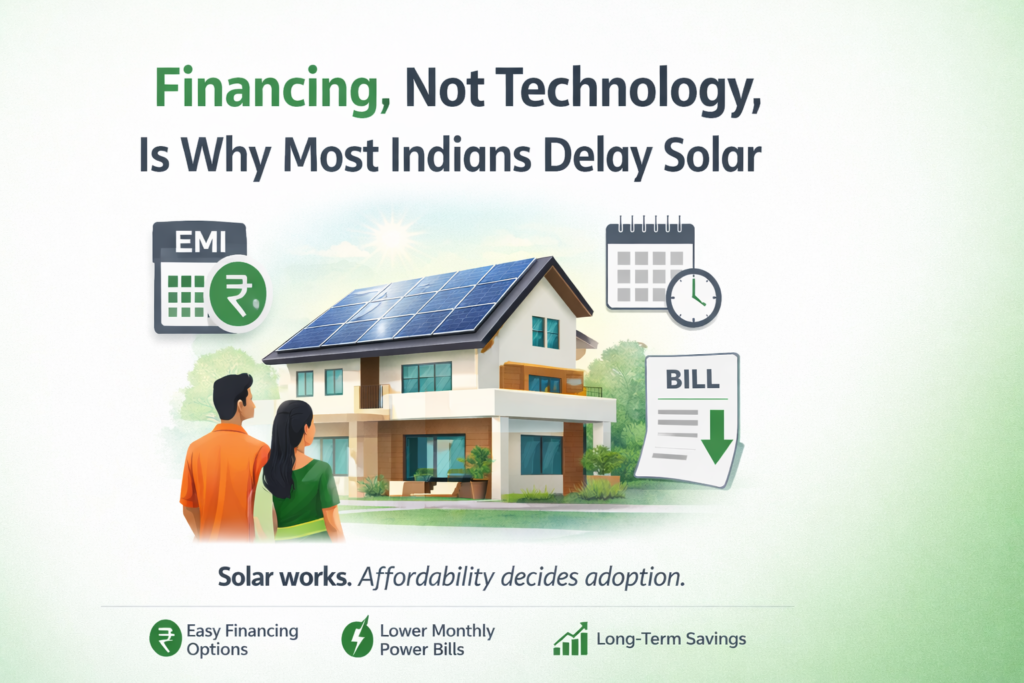
Financing, Not Technology, Is Why Most Indians Delay Solar

Across India, households, MSMEs, hospitals, schools, and even banks agree on one thing: solar works. Rooftop Solar lowers bills, reduces dependence on the grid, and supports India’s clean energy goals. Yet adoption still moves slower than expected. The biggest reason isn’t technology, space, or awareness. It is financing. For most consumers, the decision to go solar stops at one question: “How do I pay for it without stressing cash flow?”


  • Explain why intent fails without financing clarity

  • Decode consumer fears around upfront solar costs

  • Show financing as catalyst for faster adoption

  • Highlight why delay increases long-term losses

A typical 5–10 kW rooftop solar system can save ₹50,000–₹1 lakh annually for homes and small institutions. Larger commercial rooftops can save ₹10–30 lakh per year. Still, many consumers hesitate because the upfront investment feels heavy, even if returns are attractive. People compare solar to an expense, not an asset. Financing changes that mindset by converting a one-time cost into manageable monthly payments, often lower than existing electricity bills.

The challenge is not lack of schemes or lenders. Financing options exist, but they are fragmented and poorly explained. Consumers worry about interest rates, hidden conditions, ownership, maintenance responsibility, and what happens if generation drops. Without a trusted partner to simplify this journey, financing becomes confusing instead of empowering. As a result, people delay decisions while continuing to pay rising grid tariffs that increase 5–8% every year.

This is where structured financing unlocks real adoption. When consumers see that solar can be installed with minimal upfront payment, predictable EMIs, and long-term performance assurance, decisions accelerate. In many cases, savings start from the first month. Financing does not just make solar affordable; it makes it immediately practical. Waiting, on the other hand, quietly burns money every billing cycle.

At Zero Carbon, we see financing as a bridge between intent and action. Our vision—“Every roof powering India, zero carbon emissions”—depends on removing friction. That is why we design solutions where technology, financing, and execution work together. From Rooftop Solar and Open Access to Wind–Solar Hybrid systems, supported by 25-year warranties, PAN-India teams, and top-tier brands, the goal is simple: make switching effortless and reliable.

The truth is clear. Financing remains the critical factor in consumers opting to switch to solar. Those who act early protect themselves from tariff shocks and build long-term resilience. Those who wait keep paying more for the same power.

Open Access Solar Power: A Smarter Way to Power Your Business

Rising electricity costs and sustainability goals are pushing businesses to rethink how they source energy. Open Access Solar Power offers a powerful solution — combining cost efficiency, reliability, and clean energy at scale.

With Open Access Solar, eligible commercial and industrial consumers can source electricity directly from large solar power plants through long-term agreements, without installing panels on their own premises. This model allows businesses to benefit from utility-scale solar power while staying connected to the grid.

⚡ Why Businesses Are Choosing Open Access Solar

  • Lower power costs compared to conventional grid tariffs

  • No rooftop or land requirement at your facility

  • Stable, predictable energy pricing through long-term PPAs

  • Significant reduction in carbon footprint

  • Supports ESG, RPO, and net-zero commitments

At  Zero Carbon, we help businesses plan, structure, and execute Open Access Solar projects — from feasibility and regulatory support to end-to-end execution.

If your business has high power consumption and wants cleaner, more affordable energy, Open Access Solar could be the right next step.

Clean Energy • Lower Costs • Scalable for Business

Power Your Business with Reliable, Cost-Efficient Solar Energy

Transform your commercial property into a sustainable energy hub with our customized Commercial Solar Solutions — engineered for maximum savings, energy independence, and environmental impact.


Rising electricity costs, increasing sustainability expectations, and grid reliability challenges are pushing businesses to rethink how they power their operations. One solution is proving to be both financially and environmentally powerful —

Financial Benefits of Commercial Solar Power

One of the biggest advantages of commercial solar is its strong financial return. Most businesses experience:

  • Rapid payback periods

  • Long-term savings over the system’s lifetime

  • Reduced exposure to rising electricity prices

By generating clean power onsite, businesses convert unused rooftop space into a revenue-saving asset.


Sustainability, ESG & Brand Value

Beyond cost savings, solar energy helps organizations meet sustainability goals and reduce their carbon footprint. Commercial solar systems produce clean, emission-free energy, helping businesses align with:

  • ESG reporting requirements

  • Corporate sustainability goals

  • Green building certifications

Customers, investors, and partners increasingly prefer businesses that demonstrate real

environmental responsibility — not just promises.


Who Can Benefit from Commercial Solar?

Zero Carbon’s Commercial Solar Solutions are ideal for:

  • Office buildings and corporate campuses

  • Manufacturing plants and industrial units

  • Warehouses and logistics facilities

  • Hotels, hospitals, and educational institutions

  • Retail malls and commercial complexes

Whether you operate a single facility or multiple locations, solar can scale with your business.

The Zero Carbon Advantage

Choosing the right solar partner is as important as choosing solar itself. With Zero Carbon, businesses gain:

  • Transparent engineering and honest assessments

  • Quality-driven system design

  • Reliable execution and after-sales support

  • A long-term partner focused on performance and impact

We don’t just install solar systems — we build energy solutions that work for decades.


Conclusion: Power Your Business with Confidence

Commercial solar is one of the smartest investments a business can make today — reducing costs, improving energy security, and contributing to a cleaner future.

If you’re ready to take control of your energy and turn your rooftop into a powerful asset, explore Zero Carbon’s Commercial Solar Solutions