
Ask anyone who ran a factory, a hospital or a school in 2013 what they remember about electricity. The answer is usually the same: diesel generators, inverters, and planning the day around load-shedding.
That was not a perception problem. It was a supply problem.
In 2013-14, India’s energy deficit stood at 4.2%, and peak shortage at 4.5%, roughly 6,100 MW of demand that simply could not be met at the busiest hour. Installed generation capacity was about 249 GW.
Twelve years later, the picture has changed completely.
The numbers that tell the story
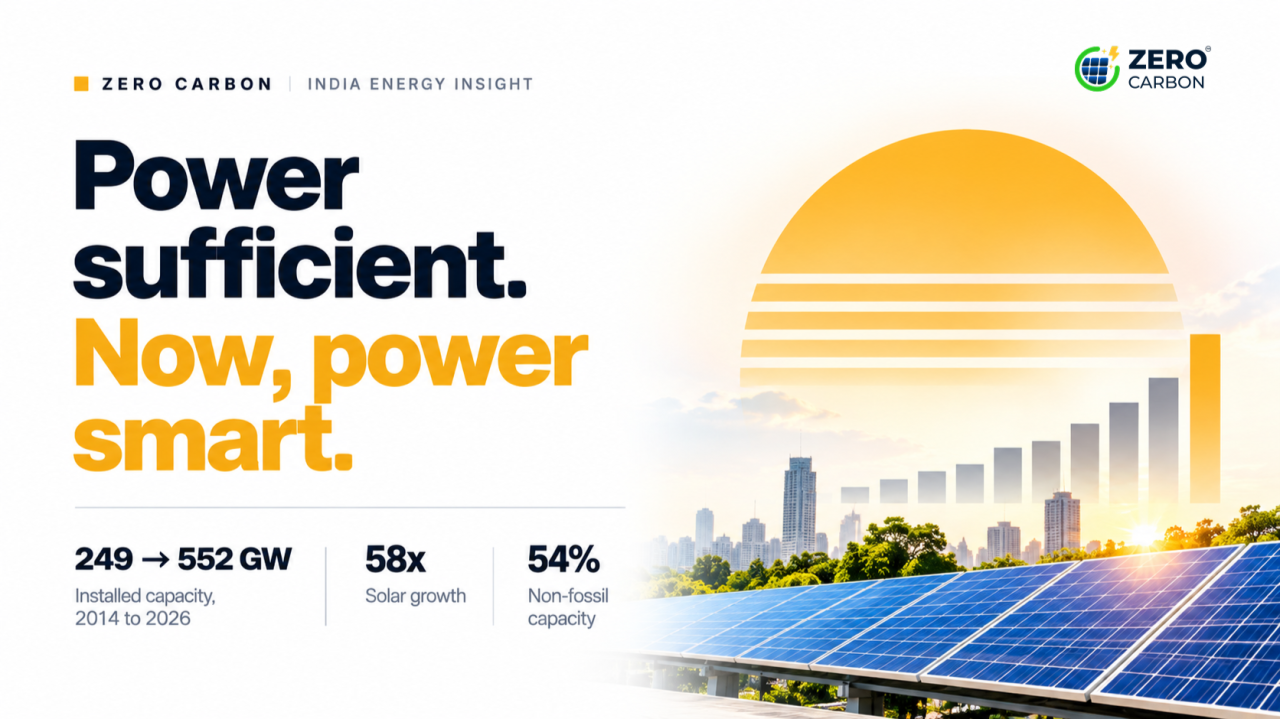
→ 249 GW to 552 GW. India’s installed power capacity has more than doubled since 2014, reaching around 552 GW by July 2026.
→ Over 54% non-fossil. India crossed 300 GW of non-fossil capacity on 31 July 2026, meeting its 2030 NDC goal of 50% non-fossil capacity five years early.
→ Renewables: ~30% to ~53%. Renewable capacity (including large hydro) was about 75.5 GW in 2014, roughly 30% of the installed base. Today it stands near 292 GW, about 53%.
→ Solar: 2.82 GW to 164.59 GW. Nearly 58 times in twelve years. Solar alone is now close to 30% of India’s installed capacity.
→ Record year. FY 2025-26 added 55.29 GW of non-fossil capacity, the highest ever, with solar contributing 44.6 GW.
→ Made in India. Listed solar module manufacturing capacity has grown from 2.3 GW in 2014 to over 170 GW.
→ Rooftop is real. Over 30 GW of grid-connected rooftop solar is now operating across homes, offices, factories and public buildings.
The country moved from power deficit to power sufficiency. That is a genuine national achievement.
The new challenge is not capacity. It is control.
Here is the part that headline numbers hide.
Capacity is not the same as generation. Coal still supplies around 70% of the electricity India actually consumes, because a solar plant produces only when the sun is up, and a wind farm only when the wind blows.
And demand is changing shape:
✓ Peak demand is projected at about 289 GW in FY 2026-27, rising past 380 GW by 2031-32.
✓ AI data centres alone are expected to add 26.3 GW of new load by 2031-32, nearly double the earlier estimate. These loads are spiky and ramp sharply, which the grid operator has flagged as a stability risk.
✓ Transmission is not keeping pace with renewable additions, and curtailment (clean power the grid cannot absorb) is rising.
This is why the government is now pushing AI-based tools for forecasting, congestion management and renewable integration. The grid India built was designed for power flowing one way, from a few large plants to consumers. Today it must balance millions of variable sources in real time.
What this means for businesses
For commercial and industrial consumers, this transition creates a clear opportunity.
▸ Generate where you consume. Rooftop and captive solar reduces dependence on grid tariffs and on transmission capacity that is already stretched.
▸ Add storage, not just panels. Battery storage turns daytime solar into evening reliability, and is becoming central to how developers manage curtailment.
▸ Think open access. Captive and group captive solar let large consumers lock in long-term green power at predictable cost.
▸ Plan for a smarter grid. As DISCOMs and grid operators adopt AI-led management, consumers with monitored, well-engineered assets will be better placed for time-of-day tariffs and demand response.
India solved the problem of not having enough power. The next decade is about using that power intelligently, and businesses that generate, store and manage their own energy will lead that shift.
At Zero Carbon, we develop, engineer and deliver rooftop, captive open access, hybrid and BESS projects for commercial and industrial clients across North and South India.
If you are evaluating solar for your facility, let’s talk.