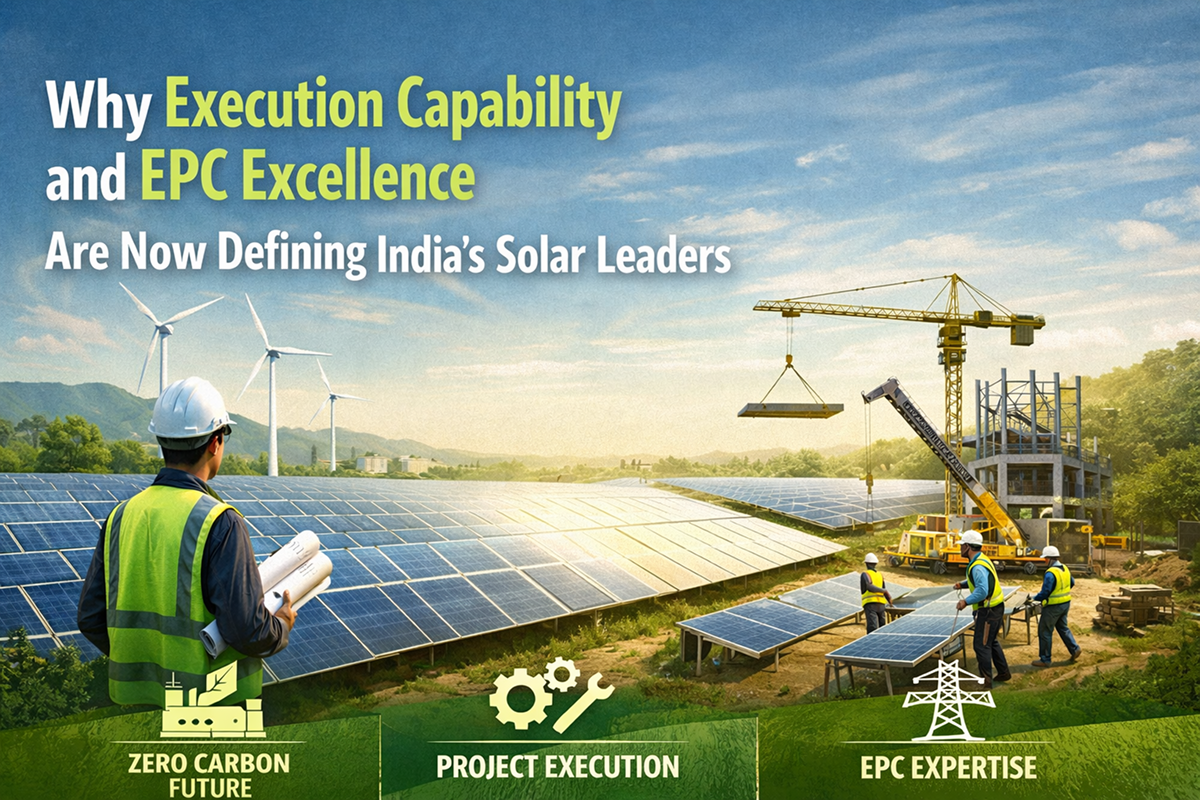

India has moved into a new phase of its solar journey. The early years were defined by capacity addition—how many megawatts were installed and how fast. Today, the focus has decisively shifted. Execution capability is becoming the real currency in solar. The quality of decisions across the project lifecycle now determines whether a solar plant becomes a long-term asset or a short-lived installation.
From land selection and site grading to layout optimisation, equipment integration, and risk management, every stage impacts generation performance. Poorly planned land can lead to shading and drainage issues. Sub-optimal layouts reduce energy yield. Weak integration between modules, inverters, and BOS components increases downtime. These are not minor errors—they directly affect plant profitability for 25 years.
EPC Excellence as the Core Differentiator
In this environment, EPC capability has become the strongest competitive advantage. Companies that bring engineering depth, process discipline, and on-ground execution strength are shaping India’s next solar wave. It is no longer enough to win tenders; projects must be built to perform consistently in Indian conditions—high temperatures, dust, monsoons, and grid variability.
This is especially critical as India scales up ambitious targets under initiatives like PM Surya Ghar, state solar policies in Rajasthan, Gujarat, Maharashtra, and Tamil Nadu, and large renewable investments by players such as Adani Green, Tata Power, and ReNew. As capacities grow, so does complexity—and execution quality becomes the difference between success and underperformance.
The Power of Strong Manufacturing Linkages
Another defining factor is manufacturing linkage. EPCs with direct relationships with Tier-1 module, inverter, and structure manufacturers are better positioned to manage quality, timelines, and warranties. With India pushing domestic manufacturing under Make in India and PLI schemes, tight integration between EPC and manufacturing is reducing supply risk and improving lifecycle performance.
Strong linkages also ensure faster resolution of defects, better technology access, and long-term support—critical for assets expected to operate for decades.
Turning Megawatts into Assets
India’s next phase of solar expansion will be shaped by those who can combine ambition with execution strength. The goal is no longer just to commission projects, but to turn megawatts into productive, resilient assets that deliver predictable returns year after year.
For developers, corporates, and institutions, choosing the right EPC partner is now a strategic decision—not a procurement exercise. Those who prioritise execution capability will lead the market.
As India accelerates its renewable journey, now is the time to partner with execution-focused EPCs who understand engineering, manufacturing, and lifecycle performance. The future of solar belongs to those who build it right.
Key Shifts:
– Execution quality now defines long-term solar asset performance and financial returns
– EPC excellence is replacing capacity as the true competitive advantage
– Manufacturing integration reduces risk and improves project reliability
– Lifecycle thinking is reshaping how solar projects are planned and built
– India’s solar leaders will be those who execute, not just announce