
-
Explain how GST cuts reduce upfront solar costs
-
Show real payback impact for businesses
-
Highlight why delaying solar now costs more
-
Connect policy change to long-term savings
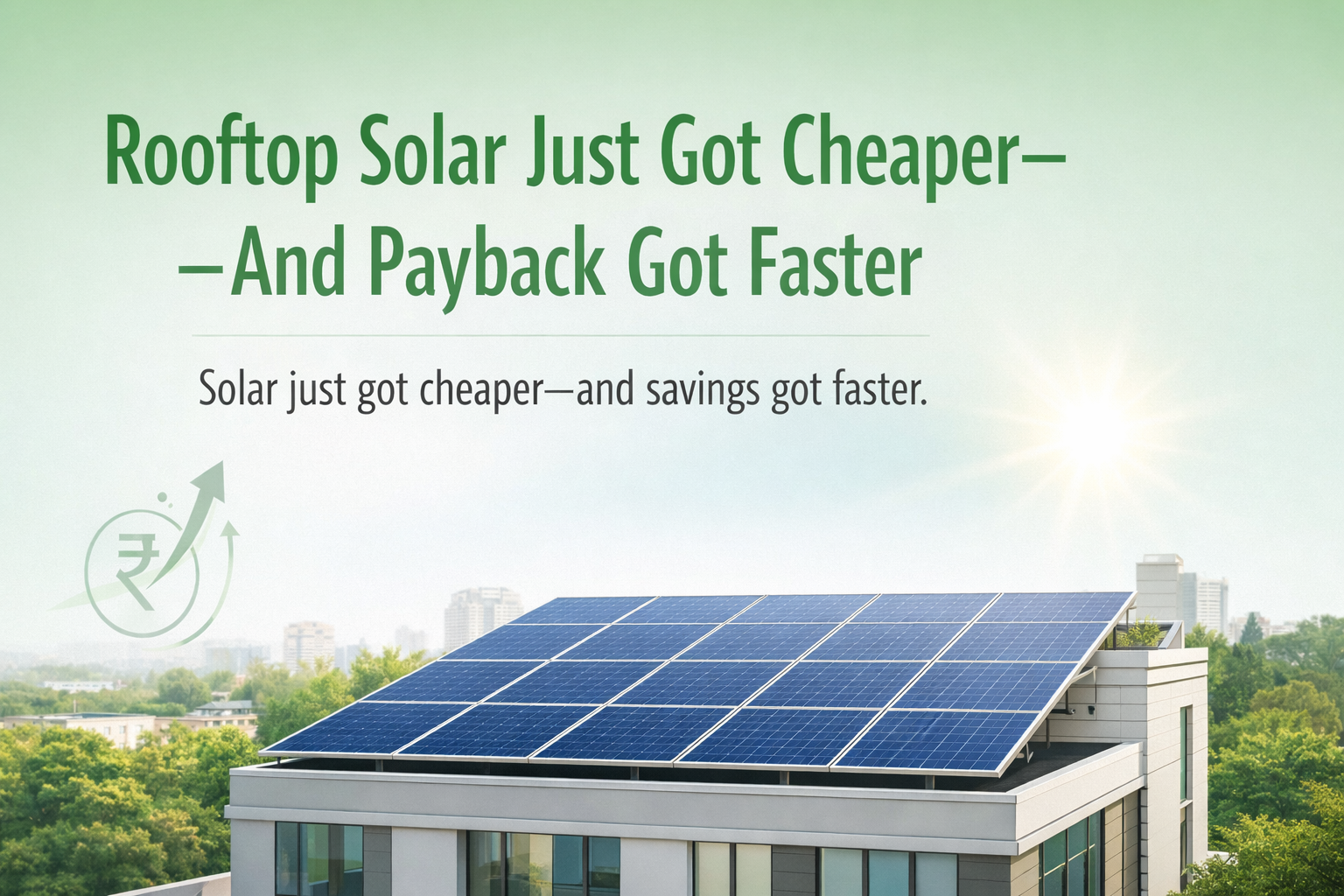
Rooftop solar has quietly crossed a major affordability milestone in India. With recent GST adjustments, rooftop solar system costs have dropped by 7–10%, making clean energy more accessible for MSMEs, hospitals, schools, banks, and factories. This may sound like a small percentage, but when applied to capital-intensive systems, the impact on payback and lifetime savings is significant.
For a typical commercial rooftop installation, capital cost is the biggest mental barrier. A 100 kW system that earlier required ₹45–50 lakh can now be installed at noticeably lower cost. That reduction directly shortens the payback period by 6–12 months, depending on consumption patterns. For energy-intensive users paying ₹9–₹14 per unit from the grid, this means faster breakeven and higher internal rate of return. In simple terms, businesses start saving sooner.
What makes this moment important is timing. Electricity tariffs continue to rise 5–8% annually, while solar technology costs keep falling. GST rationalisation accelerates this trend. The economics now clearly favour immediate adoption. Waiting no longer means “thinking it through”; it means paying inflated bills while missing cheaper installation windows. Every delayed month is another high-cost electricity bill locked in.
For institutions like hospitals and schools that operate year-round, or BFSI branches with predictable loads, the savings are tangible. A mid-sized hospital can save ₹20–40 lakh per year after installing rooftop solar. With reduced system cost, those savings now compound faster. Over a 25-year system life, the difference created by a 7–10% cost drop can translate into ₹1–2 crore extra retained capital.
At Zero Carbon, we see this shift clearly across projects. Our vision—“Every roof powering India, zero carbon emissions”—is built on aligning policy momentum with reliable execution. We deliver Rooftop Solar, Open Access Solar, and Wind–Solar Hybrid solutions, backed by 25-year warranties, PAN-India teams, and top-tier brands. Cost reductions only matter when systems perform consistently over decades—and that’s where engineering and service quality decide outcomes.
The bigger picture is simple. Rooftop solar is no longer just environmentally responsible; it is financially urgent. GST cuts have lowered the entry barrier, payback cycles are shorter, and tariff pressures are rising. Businesses that act now lock in lower costs and long-term energy certainty. Those who wait will likely pay more for the same transition.